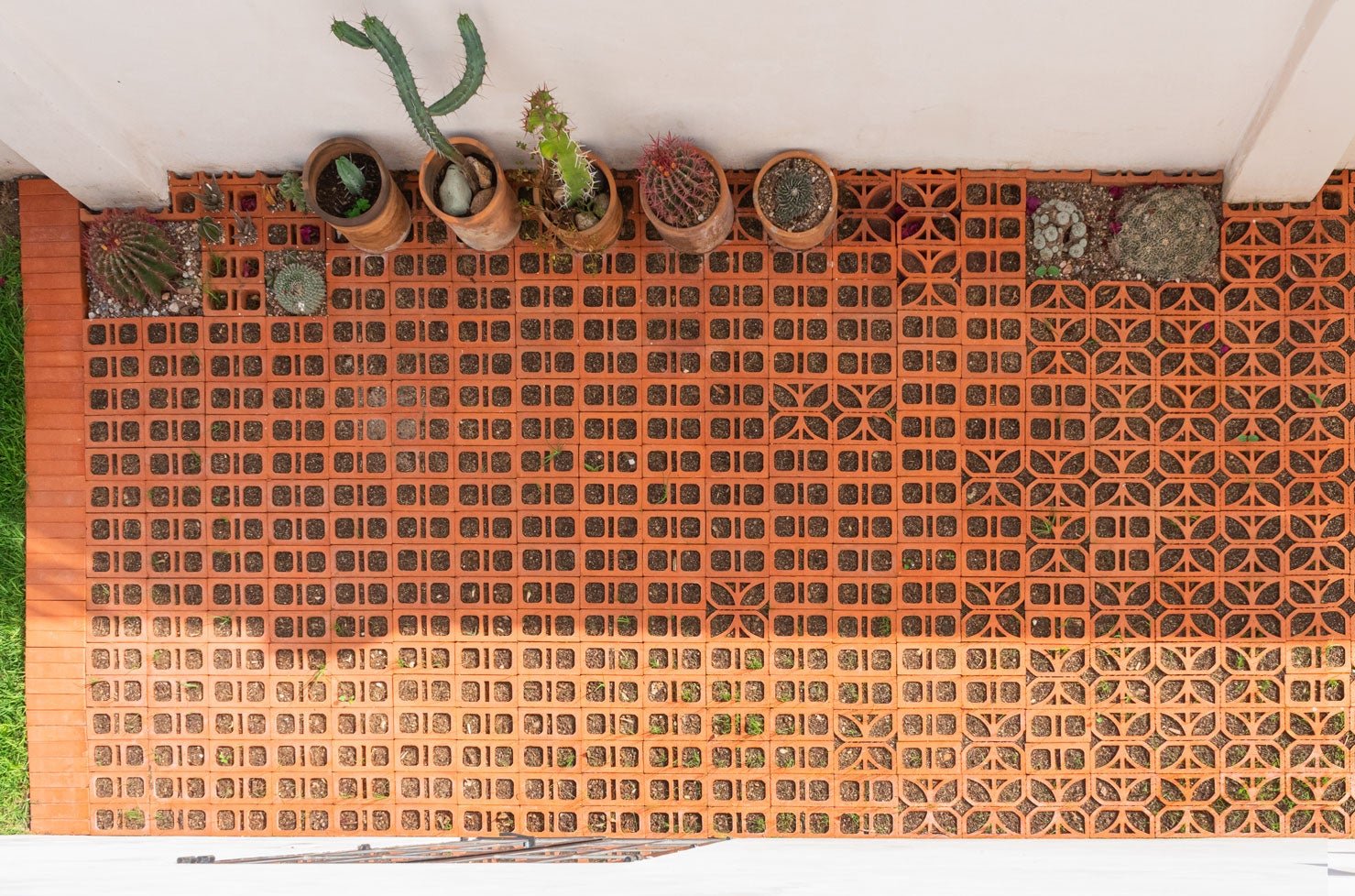
A practical pool equipment enclosure becomes an architectural backdrop with Clay Import’s dimensional terracotta “Angle Brick”
Pools come with a few necessities that aren’t exactly designed to be beautiful. Pumps, filters, cleaning equipment, and pool supplies all need a place to live, and that often means a utility room or equipment enclosure sitting somewhere within the landscape.
We hear from clients who want to know how to hide pool equipment without taking away from their outdoor design, and for years, we had the same question at our San Miguel de Allende studio.
Our pool is surrounded by terracotta, plants, cacti, and warm natural materials, so we wanted the solution to feel intentional rather than simply covering up something we didn’t want to see.
The answer became a new architectural feature and a new way of looking at the humble brick.
- From Pool Pump Enclosure to Poolside Feature Wall
- What Is Angle Brick?
- How We Installed Angle Brick on the Wall
- More Ways to Use Angle Brick
- Designing With Light, Shadow, and Terracotta
- Sometimes the Practical Solution Becomes the Best Part

From Pool Pump Enclosure to Poolside Feature Wall
Our pool pump room is partially underground and partially above ground, with a large access hatch that needs to remain functional.
Over the years, we considered several ways to disguise it. Could we turn it into built-in seating? Cover the entire structure in tile? Create a small poolside lounge area?

Our pool pump room is partially underground and partially above ground, with a large access hatch that needs to remain functional.
Ultimately, we decided we didn’t want the equipment enclosure to become the focal point at all. Instead, we built a partition wall in front of the pool pump area, creating a visual screen between the equipment and the rest of the garden.
But a plain wall didn't feel like enough.
We wanted the new wall to contribute something to the landscape, especially because it would also become part of the backdrop to the pool. That idea led us to Angle Brick, a dimensional terracotta brick that transforms a practical privacy wall into an architectural feature.
What Is Angle Brick?

Angle Brick takes a familiar material and changes its geometry.
The terracotta brick features an angular, dimensional form created by a diagonal profile. When multiple pieces are installed together, their projecting surfaces create a repeating geometric pattern with pronounced depth and shadow.
In the San Miguel de Allende garden, we arranged the bricks vertically across the partition wall. The dimensional faces catch sunlight differently throughout the day, giving the wall a constantly changing texture.
And because it is natural terracotta, the material feels right at home alongside the garden's clay planters, cacti, greenery, and surrounding architecture.
It's functional screening, but it doesn't look like something that's simply there to hide a pool pump.
How We Installed Angle Brick on the Wall
For this project, we first constructed a partition wall in front of the pool equipment area while maintaining access to the pump hatch behind it.

Rather than using a traditional grouted installation, the Angle Bricks were set into a thick custom-pigmented mortar bed and pressed firmly against the wall.

The terracotta-tinted mortar extends slightly into the spaces between the bricks, helping create adhesion both to the substrate and between neighboring pieces.
We intentionally skipped a conventional grout application. Because of the depth and geometry of Angle Brick, working grout into every seam after installation would be difficult and potentially messy. Using the mortar as part of the installation allowed us to maintain the dimensional character of the pattern without filling all of those intricate spaces afterward.
For similar exterior architectural installations, the substrate, waterproofing, mortar, drainage, climate, and structural requirements should always be evaluated for the specific project.
More Ways to Use Angle Brick
Although our first goal was to hide pool equipment, the project made us think about all the other places where a dimensional terracotta brick could be used.

- Outdoor privacy screens and garden walls. Create separation between a patio, pool, outdoor shower, or entertaining area and less decorative parts of the landscape.
- Pool backdrops. A dimensional brick wall can become a warm, textural background behind a swimming pool, especially when paired with greenery and terracotta planters.
- Outdoor kitchens. Use Angle Brick to add texture to an outdoor kitchen wall, bar surround, or adjacent architectural feature.
- Garden paths and walkways. At approximately two inches thick, Angle Brick can also be considered a paver, with a sand-set style installation, creating a more geometric alternative to traditional square and rectangular terracotta pavers.
- Patios and courtyards. Incorporate the brick into outdoor flooring to introduce subtle pattern and movement while maintaining the warmth of natural clay.

- Home façades. Use Angle Brick as an architectural accent to break up large exterior surfaces or highlight an entryway.
- Entry walls and front courtyards. A smaller installation can create a strong first impression without covering an entire façade.
- Fireplace surrounds and feature walls. The sculptural profile can add depth to areas where a conventional flat brick might feel too simple.
- Interior accent walls. Bring the texture indoors in spaces such as entryways, mudrooms, laundry rooms, bars, or other areas where a tactile natural material can become part of the design.
- Planter and landscape features. Incorporate Angle Brick into raised planters or landscape walls to connect architecture with the surrounding garden.
Designing With Light, Shadow, and Terracotta

One of our favorite things about dimensional materials is that they don't rely on color alone to make an impact.
As sunlight moves across Angle Brick, the projecting surfaces create highlights and shadows that emphasize its geometry. From straight on, you see a repeating terracotta pattern. From the side, the depth of each piece becomes much more apparent.
That makes the material particularly interesting outdoors, where the appearance of the wall naturally evolves from morning to evening.
And unlike simply hiding the pool equipment behind a generic fence or enclosure, the finished wall becomes something worth looking at.
Sometimes the Practical Solution Becomes the Best Part
This project started with a very ordinary problem: How do we hide our pool pump?
The solution reminded us that practical elements don't always need to disappear completely. Sometimes, they can give us an opportunity to introduce a new material, texture, or architectural detail.

Angle Brick begins with one of the simplest building materials: the terracotta brick, and rethinks its shape to create something dimensional, contemporary, and playful.
What was once an awkward pool equipment area is now a textural garden wall and backdrop for the pool.
Sometimes, a small architectural intervention is all it takes to completely change how a space feels.