There is something especially compelling about tile that changes as you move past it. A raised edge catches the light, a recessed line falls into shadow, and a surface that seemed quiet from across the room suddenly becomes much more expressive up close. That is the appeal of 3D tile: it adds depth without relying on a busy pattern, and it gives walls a more architectural presence.
At Clay Imports, that interest in dimension has taken shape through collaborations with designers who approach clay from very different points of view. The collection with Amy Pigliacampo feels restrained, sculptural, and rooted in architectural form, while the work with Rock Paper Build brings in a more playful, distinctly Texan sensibility. Together, they show just how much range there can be in a tile that refuses to stay flat.
- When the Surface Becomes the Pattern
- Amy Pigliacampo’s Soft Approach to Dimension
- Rock Paper Build Brings Personality to the Surface
- Why 3D Tile Feels So Relevant
- More Than a Flat Finish
When the Surface Becomes the Pattern
Most tile patterns are created with color, repetition, or contrast. With dimensional tile, the surface itself does much of that work. A groove can become a line, a curve can create rhythm, and a repeated relief can make an entire wall feel more considered without asking for a complicated layout.
 Templo Mamey tile. As seen on HGTV Bachelor Mansion Takeover
That subtlety is part of what makes 3D wall tile so appealing right now. Designers are using more natural materials, warmer palettes, and finishes that feel tactile rather than overly polished, and dimensional clay fits naturally into that conversation. It has presence, but it does not need to shout.
Light is a big part of the effect. During the day, natural light can reveal the edges and recesses in completely different ways, while at night, sconces or pendant lighting can make the same wall feel softer and more sculptural. The tile does not simply sit on the surface; it changes with the room around it.
Amy Pigliacampo's Soft Approach to Dimension
The Clay Imports collection with Amy Pigliacampo explores dimension in a way that feels quiet and architectural. Developed through time spent at the Clay SMA studio in San Miguel de Allende, the collection draws from historical forms while keeping the overall language clean enough for contemporary interiors.

Pieces such as Otero, Zurco, Raya, Hueco, Petalito, Circulo, and Templo play with fluting, arcs, radial forms, and softened geometry.
None of them feel overly decorative, which is exactly what makes them so versatile. The dimensionality creates interest, but the shapes remain calm enough to sit comfortably alongside plaster walls, stone counters, natural wood, or simple millwork.
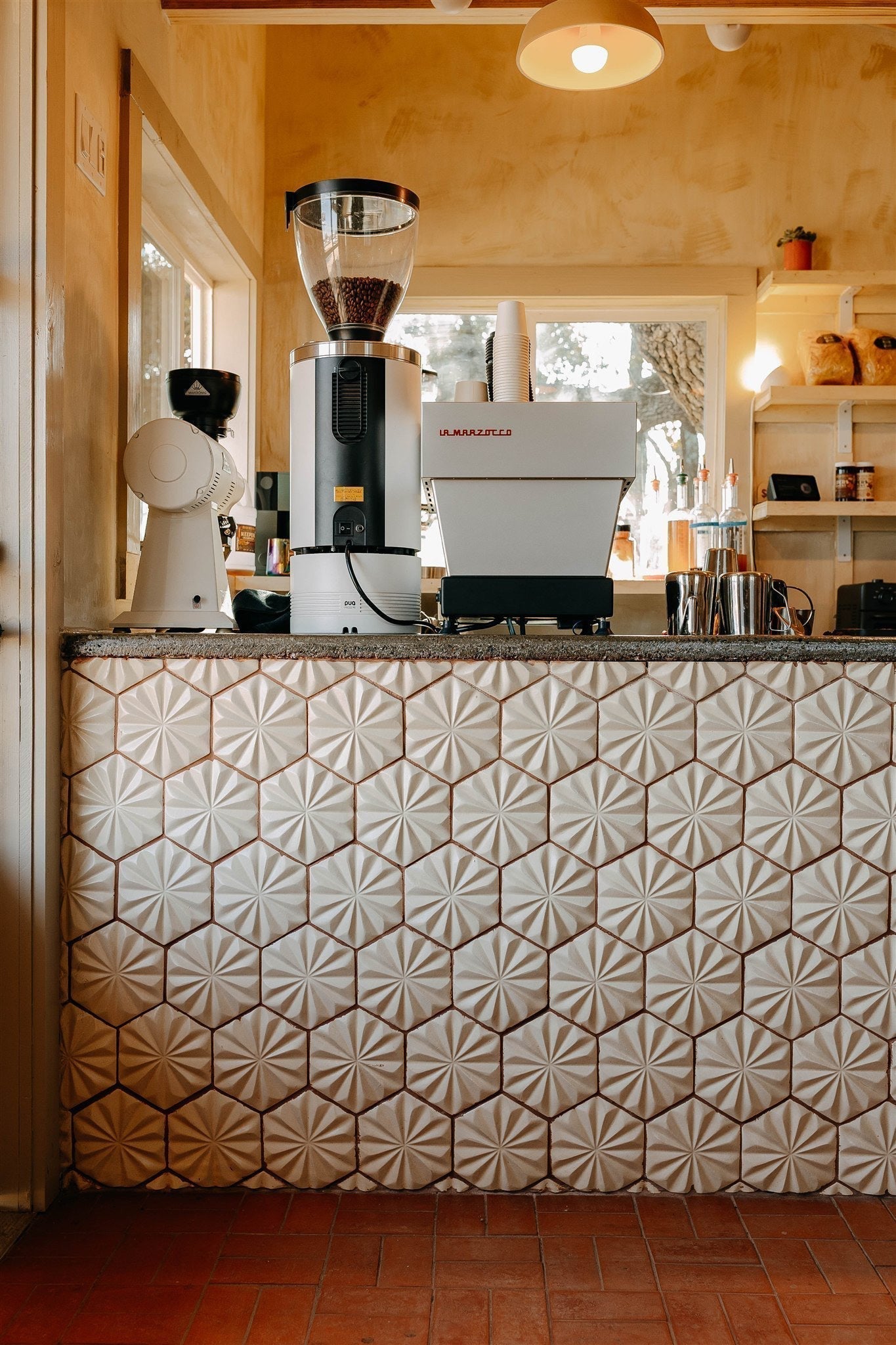
That balance is especially effective in a monochromatic installation. A wall of cream or chalky white tile can look almost minimal at first, but as the light moves across it, the relief starts to reveal itself. In a kitchen, that might mean a backsplash that feels architectural without competing with the cabinetry. In a bathroom, the same texture can add warmth to a room filled with hard, smooth finishes.
There is also something particularly satisfying about seeing dimensional forms translated through handmade clay. Small shifts in glaze and surface give each tile a slightly different relationship with the light, so the overall effect feels layered rather than uniform.
Rock Paper Build Brings Personality to the Surface
The collaboration with Rock Paper Build takes a different route. Inspired in part by vintage cowboy boot motifs and a strong sense of place, the collection brings a more graphic and playful energy to dimensional tile.
The influence is there, but it has been abstracted enough to feel architectural rather than thematic. Shapes are broken down into repeatable forms, giving the tile a rhythm that can feel orderly in one installation and looser in another.

Tacón, named after the Spanish word for heel, is one of the clearest examples. The dimensional form can be arranged in repeated patterns or paired with its counterpart to create something more freeform, giving designers room to work with both relief and composition.
What makes the Rock Paper Build collection interesting is that it treats 3D tile not simply as texture, but as a building block. The surface becomes part of a larger pattern, and the way the pieces are installed can completely change the final result.
Why 3D Tile Feels So Relevant
Part of the renewed interest in textured and dimensional tile comes from a broader shift toward interiors that feel warmer and more tactile. After years of smooth surfaces and highly controlled finishes, there is more appetite for materials that show some evidence of how they were made.
Clay naturally brings that quality into a space. With dimensional tile, it becomes even more apparent because the surface gives glaze, shadow, and variation more room to play. A ridge may catch color differently than a recess. A handmade edge may read slightly softer than the tile beside it. These are small details, but together they give an installation depth and character.

That does not mean the tile needs to dominate a room. Often, dimensional tile works best when it is given a clear role and some visual breathing room. A backsplash, fireplace surround, bar front, vanity wall, or architectural niche can be enough to make the material memorable.
The surrounding palette can stay relatively simple because the tile is already contributing so much through texture. Natural wood, stone, plaster, and muted finishes tend to pair especially well with 3D surfaces because they let the clay hold its own without turning the room into a competition of materials.
More Than a Flat Finish
At its simplest, a 3D tile is a tile with a raised, recessed, or sculpted surface that creates physical depth. In practice, though, it does something more interesting: it gives a wall a sense of movement.
The Amy Pigliacampo collection shows how quiet and refined that movement can be, while the Rock Paper Build collaboration demonstrates how dimensional tile can also be graphic, playful, and full of personality. Both approaches make the same point in different ways: tile does not have to be treated as a flat finish.
Sometimes the most interesting thing a wall can do is catch the light a little differently.